Hajdúnánás · Hajdúság

Thermal imaging survey in Hajdúnánás

Hajdúnánás is a town of about sixteen thousand people in the north of the Hajdúság region. Between its newer industrial park, older industrial sites, farm-related processing and a medicinal spa, you find both newly built halls and older buildings here.
Drive from Tiszavasvári
approx. 15 km by road
Travel zone
Zone 1: no travel fee
Exterior survey season
October to March
Municipal industrial park
approx. 10 ha

The town’s industrial tradition goes back to the 1950s; local specialities include ostrich farming (Hungary’s first ostrich abattoir is here) and straw weaving as a cottage craft.

It is roughly 15 km by road from Tiszavasvári, the largest nearby town to our base, with no travel fee.

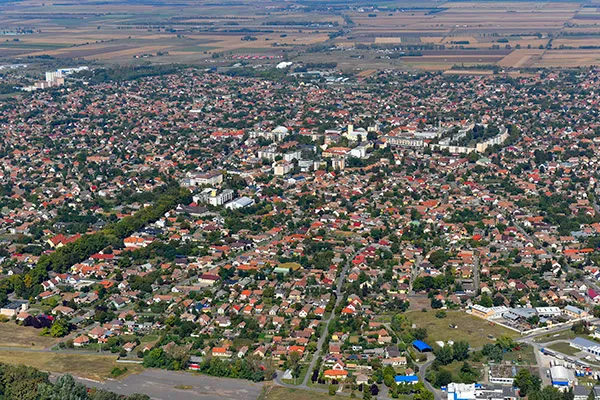
Aerial view of Hajdúnánás: blocks of family houses with farmland at the edge of the town
Hajdúnánás from the air. Industrial and farm land at the edge of town, older housing and public buildings in the centre. Image: Photo: Civertan / Wikimedia Commons, CC BY-SA 4.0

01 / Local building stock

Buildings in Hajdúnánás: a new industrial park, older sites, a spa

A new industrial park, new halls

The municipal industrial park was built on the site of the old fairground, on roughly 10 hectares, with plots aimed mainly at small and medium-sized businesses (handed over around 2022). In new halls the typical problem is not poor insulation but workmanship: gaps at panel joints, incomplete door seals, the junction of sandwich panel and base wall.

A survey after the first heating season shows these in time and gives a photo-paired record of what to fix, which you can use as a basis for talking to the contractor (it is not an official or binding document).

Older, repeatedly extended sites

The town also has an older, privately owned industrial area with warehousing and utility services. On such sites a hall built in several phases is typical: insulation quality differs between sections and the heating system has been changed more than once.

Here the camera shows differences between wall panel and roof, thermal bridges at later extensions, leaking old doors and uninsulated heating pipes.

The medicinal spa and related services

In a medicinal spa the pool hall, plant room and pipework form a typical hot, humid environment. The most common findings are moisture load on the roof and wall cladding, wet insulation and heat loss from plant-room pipes.

Operating pools do not stop us scanning the outer envelope and the plant room; indoors, humidity limits accuracy, and the report says so.

Agricultural and food-industry buildings

In buildings for ostrich farming and livestock, and in abattoir and cooled areas, panel joints, doors and ventilation are the main sources of loss. In livestock buildings we read the ventilation and heating loss together with how the building is used.

Estimate – not a guarantee. Figures are model-based and actual values may differ.

02 / Facility types

Facility types in Hajdúnánás

The pages below go into detail by facility type.

03 / Travel and season

Travel, fee and timing

In every quote the distance to the exact address decides; the values below are indicative.

Climate: The Hajdúnánás cold season, seen from a workshop hall

Using the Nyíregyháza reference data (ERA5, 11 seasons), a workshop hall heated to 18 °C has about 2,530 K·day of heating-degree-days per year, from 2,120 in a mild to 2,940 in a cold season. This is a sound approximation for Hajdúnánás industrial buildings too, since the two towns lie in the same lowland climate band.

When to book

For a newly built hall the first full heating season is the ideal moment: workmanship defects show up and can still be fixed. Heating must have been stable for at least 24 hours before the survey.

For the spa, choose a night outside busy periods but at normal operating temperature; the survey does not affect pool operation.

Hajdúnánás: approx. 15 km by road, Zone 1: no travel fee. Travel zones and fees →

Sketch map of the service area Sketch map of Tiszavasvári and the surrounding towns: dots show the approximate position of each town centre, the marker shape shows the travel zone. Nyíregyháza Nyíregyháza Tiszavasvári Tiszavasvári Tokaj Tokaj Hajdúnánás Hajdúnánás Tiszaújváros Tiszaújváros Polgár Polgár Tiszalök Tiszalök Újfehértó Újfehértó Nagykálló Nagykálló Hajdúböszörmény Hajdúböszörmény Hajdúdorog Hajdúdorog Rakamaz Rakamaz Szerencs Szerencs Tarcal Tarcal Mád Mád Tállya Tállya Kisvárda Kisvárda Balmazújváros Balmazújváros Debrecen Debrecen
  • Tiszavasvári (base)
  • Zone 1 (0–40 km)
  • Zone 2 (40–80 km)
  • Zone 3 (80–130 km)
  • Bold name: own page
Sketch map: dots show the approximate position of town centres computed from geographic coordinates; it is not a route planner. The scale bar is straight-line distance.

04 / Questions

Local questions, briefly

Is it worth surveying a newly built hall?
Yes. In new buildings the typical issue is not ageing but workmanship, and after the first season it can still be corrected. The survey gives a photo-paired record, but it is not an official handover document.
What does travel to Hajdúnánás cost?
Roughly 15 km by road from Tiszavasvári: that is travel zone 1, with no travel fee. A further building surveyed during the same visit is charged at 60% of the base price.
Can you survey the spa while the pools are running?
The outer envelope, roof, plant room and pipework can be scanned during operation. Indoors, humidity limits accuracy, and the report says so.

Nearby towns

We work across the same area; towns with their own page are linked.

Sources and note

Sources for local facts (October 2026): Wikipedia (Hungarian and English), municipal and local press; figures are rounded and indicative. Seasonal and HUF figures come from our calculation model (Nyíregyháza ERA5 reference, October 2026 gas prices).

Request a quote for your facility

Tell us the town, the type of facility and the approximate floor area; the exact travel zone and price are given in the quote.