Drone roof and PV survey
Wet flat-roof insulation at dusk, PV hot spots in full sun, wherever airspace and permits allow.
Buried pipes
A leak in a heating or hot-water pipe buried between two buildings can cost a lot in forints. We show what a thermal camera can do here, what it cannot, and when to bring in other methods before anyone digs.
01 / Honestly
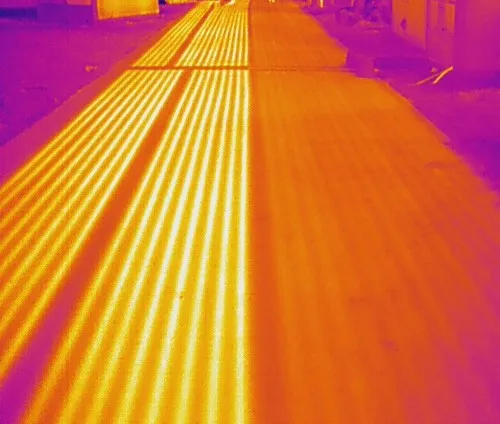
The camera sees the surface. What lies underground only shows to the extent that the soil lets it through.
A pre-insulated (PUR) hot-water pipe is built to lose almost no heat outward. When the insulation gets wet, its loss rises by an order of magnitude (measured values: 200–380 W/m), but only the part of that heat that the soil and paving let through reaches the surface. What remains at the surface is often a blurred, weak warm patch, or nothing at all.
That is why our result for buried runs is always indicative. Accessible or overhead sections (tunnel, pipe bridge, cellar) we also examine within a hall and building survey.
02 / The signal’s path
Heat does not travel straight up: it spreads, lags and weakens.
From a leaking pipe with wet insulation, heat spreads through the soil roughly spherically. Wet, compact soil conducts better than dry, loose soil. Reaching the surface, paving or grass slows it further, and by the time a patch appears it is wider and weaker than its source. Daytime solar load drowns a small contrast, which is why we measure at night, with no sun.
That is why there is no single “threshold temperature”: we compare contrast with the surroundings and take several images from several sides. If a patch coincides with the route, it is worth going further; if not, the thermal image does not confirm.
03 / Real samples
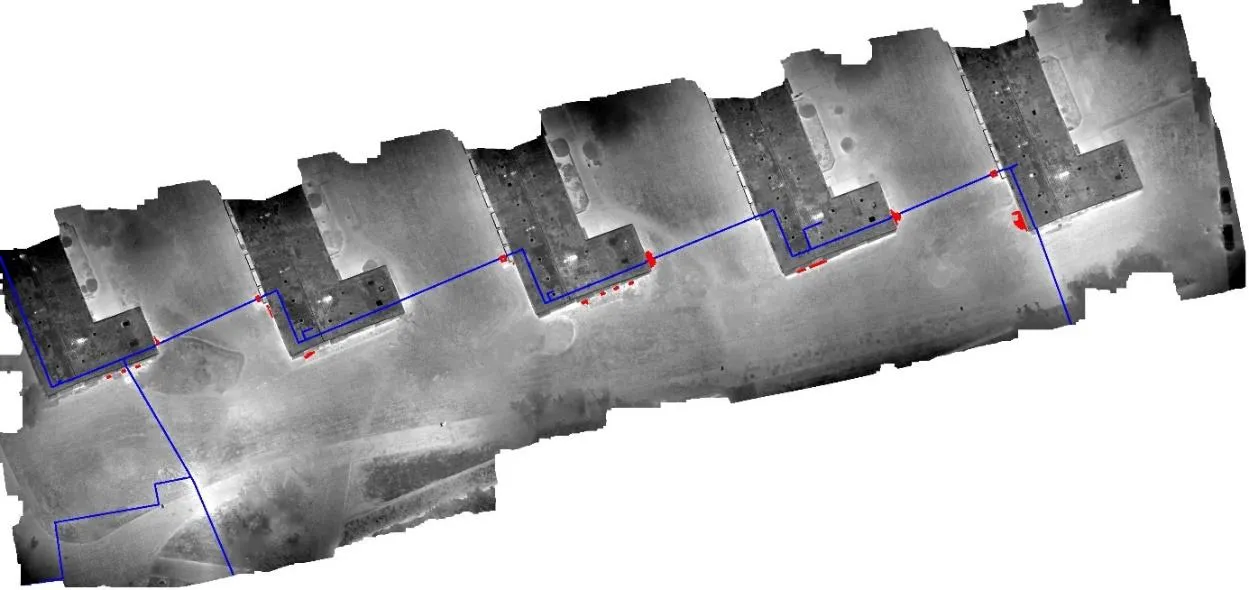
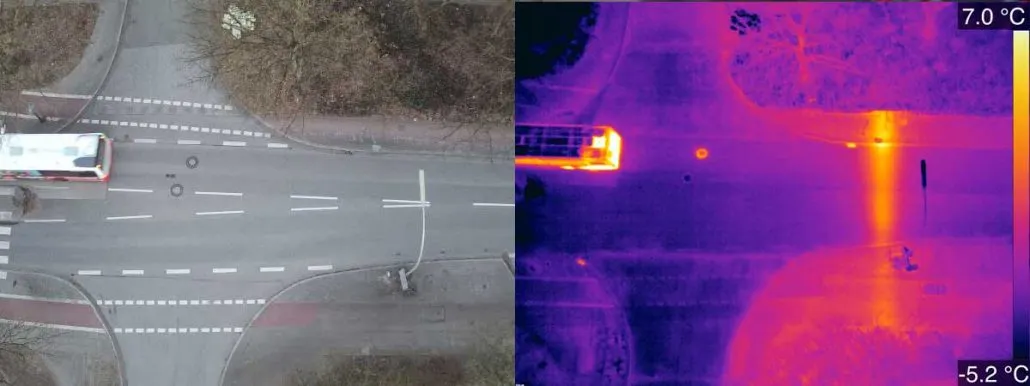
Real, openly licensed images: the surface signal sometimes shows plainly and sometimes only with analysis software. They are not our clients.
04 / Worked example
A fictional but realistic run: 25 m of wetted, pre-insulated hot-water pipe between two buildings, 80 °C flow, the leak downstream of the heat meter so the loss is billed one to one.
| Leak | Make-up water / season | Cost Ft/season (central) | Range | Payback (repair) |
|---|---|---|---|---|
| 5 l/h | 27 m³ | 1,100,000 | 590,000–1,400,000 | 33 mo |
| 50 l/h | 267 m³ | 2,100,000 | 1,200,000–2,900,000 | 17 mo |
| 500 l/h | 2,671 m³ | 13,000,000 | 7,000,000–18,000,000 | 3 mo |
Note that even a 5 l/h leak costs about HUF 1.1 million a year, because most of the cost is not the water but the roughly 27,000 kWh seasonal heat loss of the soaked insulation. And 5 l/h is only a few litres an hour: in a large district-heating network a closed-circuit water balance is reliable only above about 4 m³/h (Ljubljana district-heating study), so smaller leaks hide in the network water balance. In a smaller private system the make-up water meter is the first signal; the thermal camera is for finding the place, not for proving the leak.
The repair (excavation, repair, reinstatement) is indicatively HUF 3,000,000 (1,500,000–6,000,000) in the example: that item is bigger than the survey, which is why confirmation is needed before digging.
Illustrative example – not real measurement data.
Price basis: the heat fee is an approximation from a Budapest non-residential district-heat tariff; we take the local tariff from your invoice. Make-up water 800–2,500 Ft/m³ is an assumption. Repair costs are indicative, quote-based assumptions.
05 / Before digging
Excavation is expensive, so confirm from more than one source.
06 / FAQ
Related
Wet flat-roof insulation at dusk, PV hot spots in full sun, wherever airspace and permits allow.
Watts, kWh, m³ of gas, forints: with ranges, an A/B/C order and payback. This is what turns images into a decision.
Door seals, panel joints, condensation and ice: where refrigeration works for nothing. Also a summer product.
Tell us briefly how big and what kind of building it is and what worries you. We reply within one working day and say which package fits. Requesting a quote commits you to nothing.