3D heat map
Thermal images registered on a 3D model of your building, in a browser viewer with clickable finding cards.
Warehouse and hall
A night-time thermal survey of dock doors, sectional doors, panel joints, ridge and roof. Each finding gets a location, an estimated loss in forints and a place in the fix order.
01 / What you get
Most of the heating bill is not lost through the walls but through doors, gaps and a few soaked square metres. We find them and show which are worth fixing.
A thermal camera shows surface temperature. On a cold winter night, looking at a heated hall from outside, leaks appear as warm spots and missing insulation as bright bands. From inside you see draughts and cold surfaces. Together they make the picture.
The result is a ranked decision list, not a pile of pictures: heat loss analysis in forints and, in the 3D package, a 3D heat map.
02 / Typical findings
Four types of defect account for most of a hall’s loss. Simple physics sits behind each.
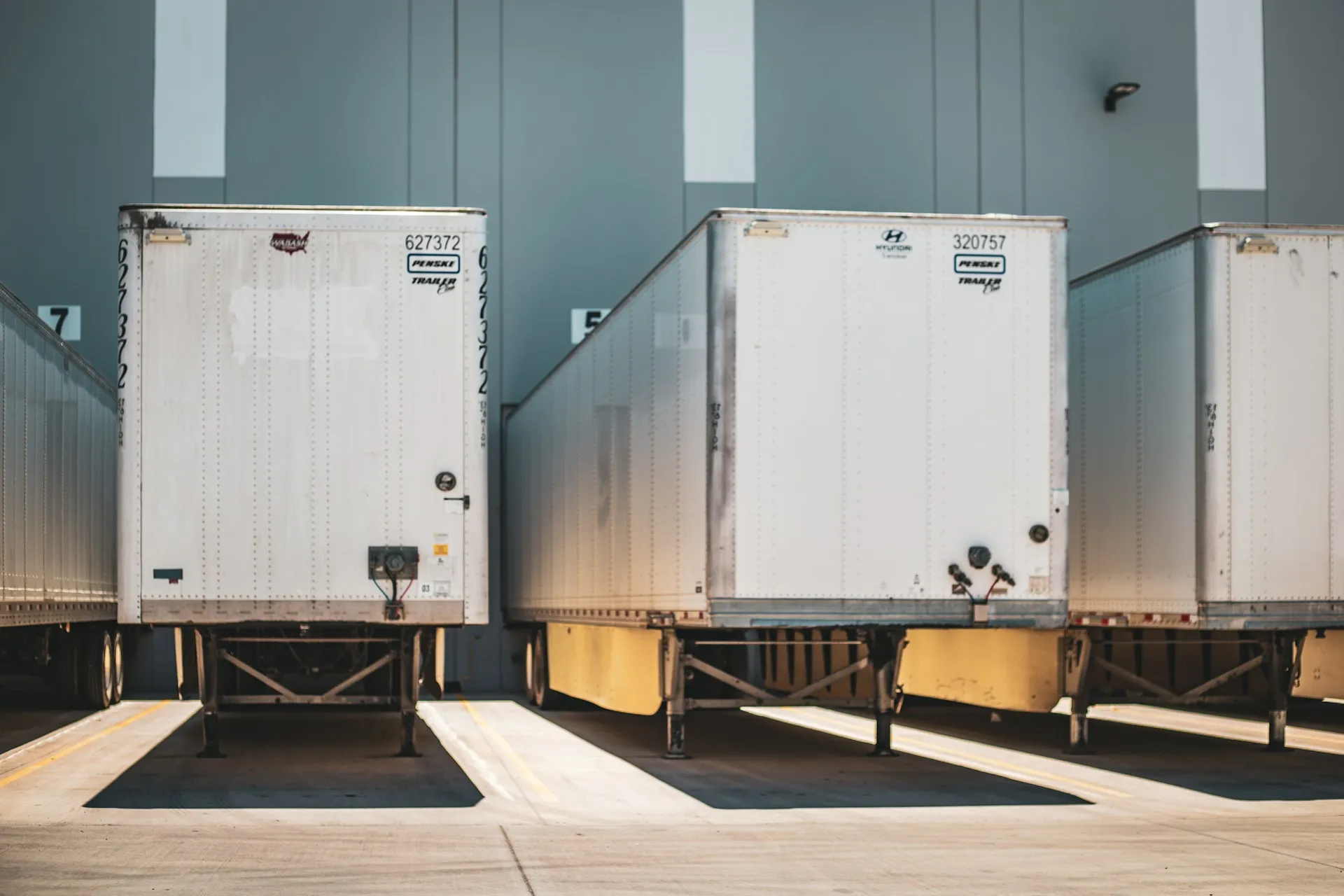
A trailer never seals perfectly against the door opening. The side pad is compressed or torn, the head curtain is incomplete, the leveler pit leaves a gap at the sides. Cold air is driven in by the pressure difference; in a thermal image a bright band appears around the trailer.
The loss follows the air volume: Q = 0.335 × V̇ × ΔT (V̇ in m³/h). A gap 1 m long and 1 mm wide passes about 5.6 m³/h at 4 Pa, which is 1.9 W/K.
Warm air rises. In a 10 m hall the pressure difference is roughly 0.4 Pa per metre of height at a 10 K temperature difference. High gaps such as the ridge and skylight perimeters therefore get the strongest driving force while make-up air enters low through the doors.
Leakage needs both an inlet and an outlet: the air that enters must also leave. We therefore model the hall as a two-level leakage network and charge a defect only with the extra flow it causes. In the 9 m example hall stack and wind together give about 3.9 Pa.
At the “widespread” level of the example a 60 m long, 3 mm ridge gap amounts to 280 W/K: about HUF 690,000 of gas per season, with an estimated fix of HUF 270,000 and a 5-month payback. All figures are estimates; ranges are below.
Wet insulation conducts heat well and stores a lot of it. An intact sandwich panel has a U-value around 0.35 W/m²K; we estimate a soaked section at about 2.5 W/m²K (range 1.5–3.5). 35 m² of wet area therefore adds roughly 75 W/K.
Wall-panel joint seals age. A 2 mm gap over 35 m comes to 110 W/K, the largest single item in the example, and cheap to fix.
Column feet, sheet-metal eaves and parapets often break the envelope without insulation. A bridge’s loss is its length times the linear transmittance (ψ). There is no openly available standard table for industrial details, so we estimate from known values for similar structures: 0.35 W/mK, within 0.10–0.80.
They show up well on camera but are rarely economic: the 45 m eaves bridge in the example is 11 W/K, about HUF 28,000 per season, against a fix of HUF 680,000. We mark it “C”. That does not mean it is unimportant (condensation, mould, any renovation) only that on gas savings alone it does not pay.
03 / Worked example
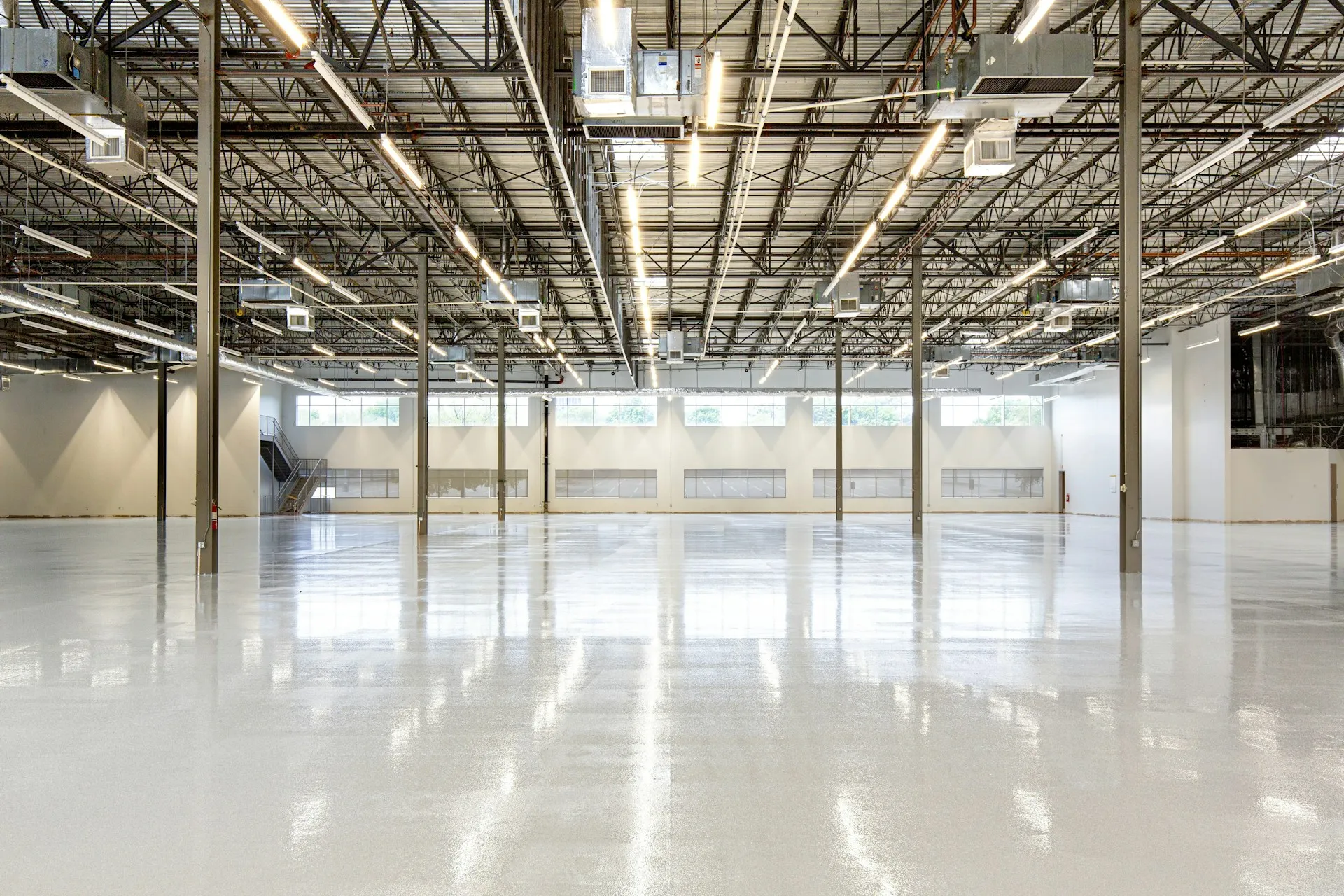
A fictional but realistic hall: sandwich-panel walls and roof, 9 m high, 16 °C, gas radiant-tube heating, Nyíregyháza area. We show the “medium” defect level.
| Prio. | Finding | W/K | Loss / season | Fix (indicative) | Payback (months) |
|---|---|---|---|---|---|
| A | Wall-panel joints open (35 m × 2 mm) | 110 | HUF 270,000 | HUF 160,000 | 7 |
| B | Sectional door 1: worn perimeter seals | 18 | HUF 43,000 | HUF 90,000 | 25 |
| B | Sectional door 2: worn perimeter seals | 18 | HUF 43,000 | HUF 90,000 | 25 |
| B | Wet roof insulation (35 m²) | 75 | HUF 190,000 | HUF 770,000 | 50 |
| C | Dock 3: head curtain incomplete | 9 | HUF 21,000 | HUF 300,000 | 171 |
| C | Dock 1: compressed side pads | 7 | HUF 16,000 | HUF 300,000 | 223 |
| C | Dock 2: compressed side pads | 7 | HUF 16,000 | HUF 300,000 | 223 |
| C | Eaves thermal bridge (45 m) | 11 | HUF 28,000 | HUF 680,000 | 292 |
| Total | 250 | HUF 620,000 | HUF 2,700,000 |
A A: pays back fast (≤ 24 months) · B B: consider (≤ 60) · C C: can wait (> 60)
What does the list tell us? Of eight items, one (the panel joint) pays back at once. All three “B” items are worth weighing; the “C” items are not fixed to save energy. Fixing everything is estimated at HUF 2,700,000 (HUF 1,400,000–HUF 5,200,000) with a simple payback of about 52 months, so we recommend a sequence, not “everything”. The same building with no defects would cost about HUF 7,540,000 per season to heat (HUF 5,990,000–10,600,000).
Estimate – not a guarantee. Figures are model-based and actual values may differ.
Price basis: net gas price on 9 October 2026, low / central / high: 32.1 / 40.4 / 56.9 Ft per invoice-kWh. Repair costs are indicative, quote-based assumptions. Method: calculation method; for your own numbers use the calculator. Survey fee: 3D package for a 2,400 m² hall is HUF 489,000, or HUF 275,000 under the pioneer programme.
04 / Measurement
An exterior thermal image is reliable when the facade has had no sun, the wind is light and the heating has been stable for a while.
We follow the principles of MSZ EN ISO 6781-1:2023; that is not a claim of certified conformity. We record temperature, wind, emissivity and how reflections were handled, and these appear in the report.
Floor plan, heating system, operating pattern, door traffic. We choose the night together.
At night we walk the hall; every thermal shot gets a visual photo from the same viewpoint. Inside: docks, doors, the under-roof zone, the effect of radiant tubes on floor and racking.
From on-site dimensions: loss, gas volume, cost, repair band and payback.
PDF report, A/B/C list, raw files, walkthrough; 3D heat map in the 3D package.
05 / Limits
Better to know in advance where a thermal camera stops.
06 / FAQ
Related
Thermal images registered on a 3D model of your building, in a browser viewer with clickable finding cards.
Watts, kWh, m³ of gas, forints: with ranges, an A/B/C order and payback. This is what turns images into a decision.
Wet flat-roof insulation at dusk, PV hot spots in full sun, wherever airspace and permits allow.
Tell us briefly how big and what kind of building it is and what worries you. We reply within one working day and say which package fits. Requesting a quote commits you to nothing.