Warehouse and hall thermal survey
Dock doors, sectional doors, ridge, panel joints, wet roof insulation, column bases: where the hall heats the outdoors.
Electrical cabinets
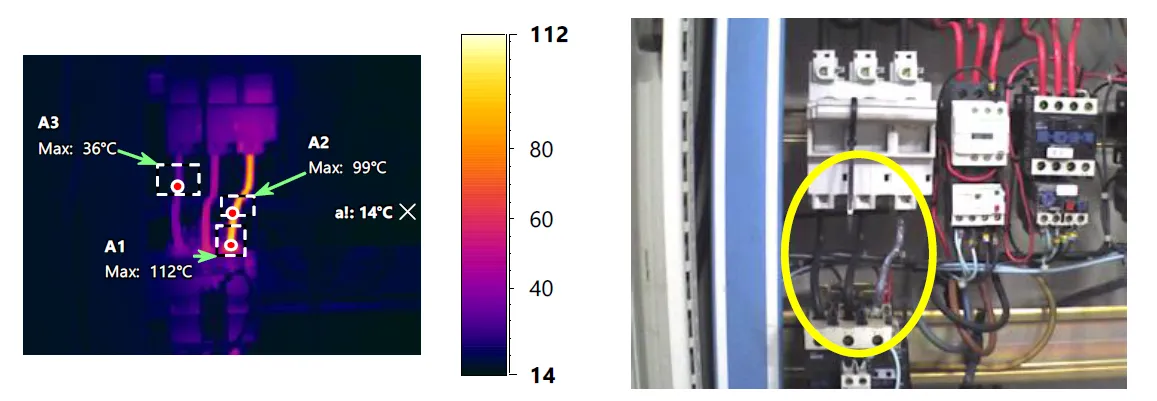
Under load, a loose or oxidised joint shows as a hot spot in the thermal image. We find it, classify it and give your electrician a work sheet. This is an early warning, not the mandatory electrical safety inspection.
01 / How it works
The visit takes an hour or two per site, depending on the number of cabinets. Safe working follows your rules.
Thermal screening takes an hour or two per site. Your authorised electrician opens the cabinet, we work with the camera from a safe distance, and the electrician gets a first view on site of which joints deserve a look.
A thermal image only makes sense under load: even a faulty joint does not heat up in an empty cabinet. So we agree beforehand when the equipment carries its usual peak current.
We agree when the cabinets carry their usual peak current. Your authorised electrician opens the cabinet; we do not touch live parts.
Joints, terminals, contactors, breakers, busbars; with a visual twin photo and the recorded load.
Based on the difference to comparable parts under equal load: watch, repair, urgent.
A report per cabinet and a findings list your electrician can work from.
02 / What we see
Real thermal images published openly under free licences: this is what a hot joint looks like. They are not our clients’ images.
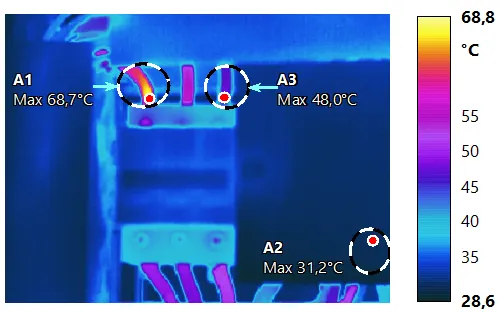
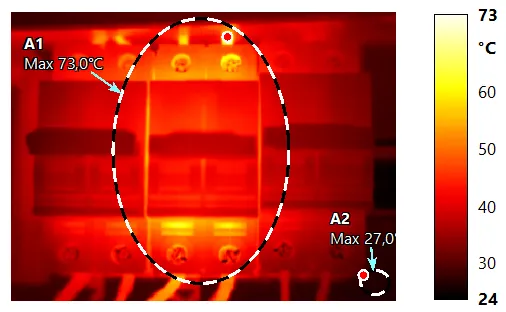
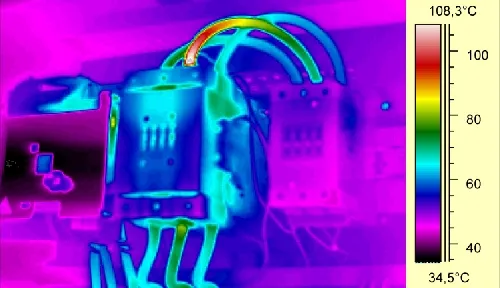
The question is not how many degrees a joint has, but how much hotter it is than a comparable part under the same load. The terminals of three phases carry the same current: if one stands out, that is the signal. That is why we measure under load, and why we do not accept “this many degrees is normal”.
Classification has three levels: watch (at next maintenance), repair (at a planned outage), urgent (discuss immediately with the electrician). Thresholds in kelvin are agreed before the visit and recorded in the report.
03 / Worked example
A fictional example: a loose terminal on a 160 A phase conductor with +0.5 mΩ of extra contact resistance, 3,000 hours a year at that load.
12.8 watts is the output of a small bulb. It still shows clearly in a thermal image because the heat concentrates in one small joint: the same power can illustratively give a local temperature rise of 13–51 K around the terminal. That is why a thermal camera gives an early warning: the joint has not failed yet, but it is already warming.
The stake is therefore failure and fire risk, which we deliberately do not put a monetary figure on because we have no reliable source for the cost of downtime. One sourced fact: of 736 fires investigated in Hungary in 2022, 73 (9.9%) had electrical energy as the cause (national disaster-management sample, investigated fires only, all building types, no breakdown for business premises; source).
The repair price depends on the electrician’s quote: terminal re-torque and checks, indicatively HUF 45,000 (HUF 25,000–HUF 90,000); terminal replacement HUF 120,000 (HUF 60,000–HUF 250,000). Screening one cabinet costs HUF 12,000 by comparison.
Illustrative example – not real measurement data.
Price basis: electricity at the October 2026 assumption of 104 / 132 / 153 Ft/kWh (net, all-in); the electrical example is detailed on the calculation method page.
04 / The line
Thermal screening and the statutory inspection serve different purposes.
| HőKép3D thermal screening | Statutory electrical inspection (VBF/EPH) | |
|---|---|---|
| Purpose | Early warning: which joint heats up under load | Proving the safety and compliance of the installation |
| Who carries it out | Our engineering team, alongside your electrician | Professionals authorised under Hungarian law |
| Result | Thermal report, classified findings list, work sheet | Statutory record and assessment |
| Replaces the other? | No | No |
05 / FAQ
Related
Dock doors, sectional doors, ridge, panel joints, wet roof insulation, column bases: where the hall heats the outdoors.
Wet flat-roof insulation at dusk, PV hot spots in full sun, wherever airspace and permits allow.
Door seals, panel joints, condensation and ice: where refrigeration works for nothing. Also a summer product.
Tell us briefly how big and what kind of building it is and what worries you. We reply within one working day and say which package fits. Requesting a quote commits you to nothing.