The short answer
When a buried pre-insulated hot-water or district-heating pipe is damaged, water soaks the insulation, the pipe's heat loss rises, and the leaking hot water warms the ground. The thermal camera shows the surface temperature, not the pipe: a fault shows where the warming of the ground reaches the surface. With shallow burial, a dry and uniform surface, at night and on an operating pipe this can work well; on a deep, well-insulated or shut-down pipe it does not.
A thermal image marks a suspect section, not an exact fault location, and “no signal” does not mean “no leak”. A finding must always be verified before anyone digs.
What happens in the ground?
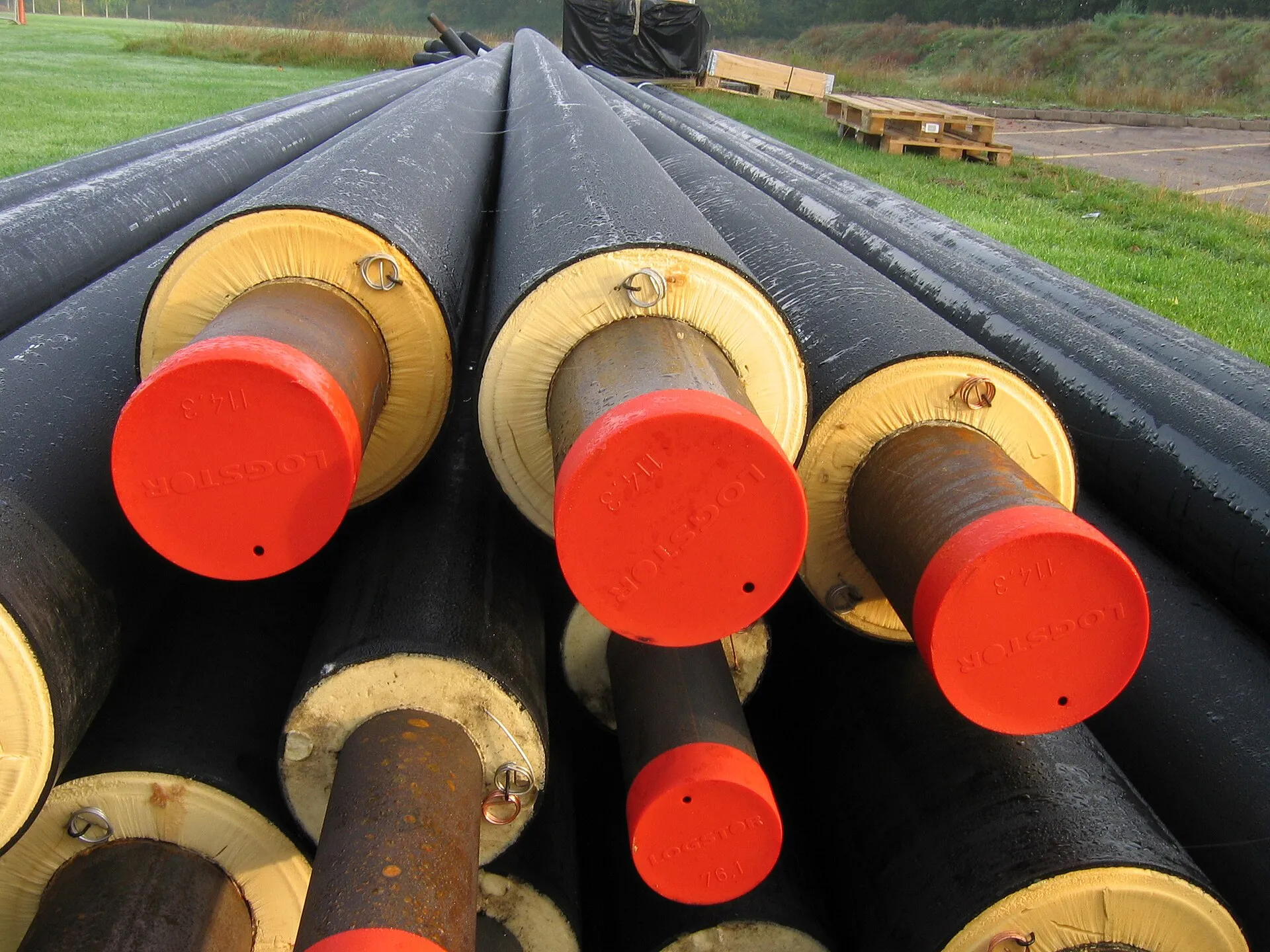
An intact pre-insulated pipe gives off little heat. If the jacket or the carrier pipe is damaged, water enters the PUR foam; wet insulation conducts heat many times better than intact insulation, so the pipe continuously heats the surrounding ground. A Ljubljana district-heating study measured 200–380 W/m of loss on wetted pipes; for small branch lines we assume a lower value of 100 W/m (the central value in our calculations is 200 W/m). If the carrier pipe leaks too, the replacement and heating of the escaping water comes on top.
When does it show at the surface, when not?
| Factor | Helps detection | Hinders detection |
|---|---|---|
| Burial depth | shallow burial, thin cover | deep burial: the ground absorbs and spreads the heat |
| Insulation condition | wet or damaged insulation: large heat flow | intact insulation: little heat gets out |
| Surface and soil | dry, uniform surface (asphalt, concrete, grass) | wet soil, snow, puddles, mixed surfaces |
| Weather | cold, dry, calm night without sun | sunshine, rain, strong wind |
| Operation | operating, warm pipe | shut-down or cold pipe: no heat signal |
| Surroundings | few other heat sources along the route | manholes, cables and other heated lines can give false signals |
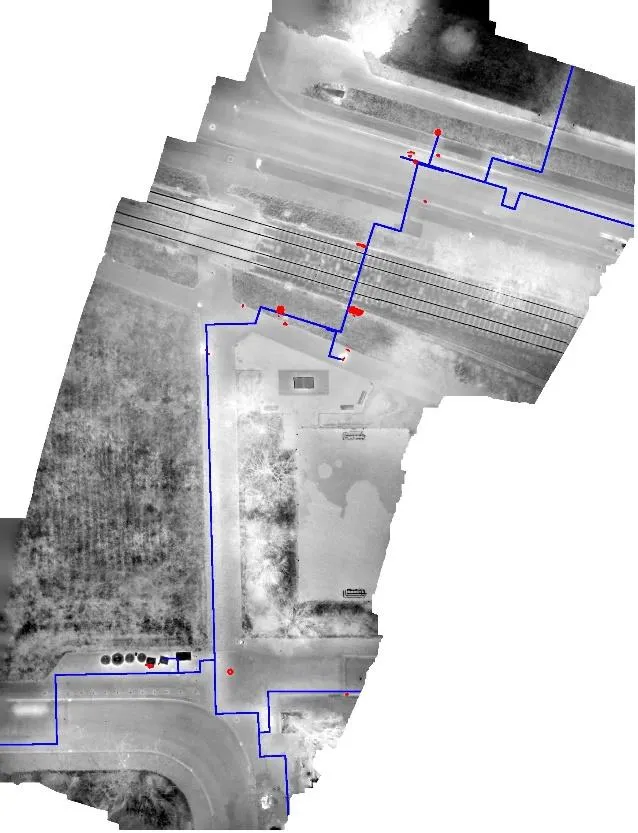
The timing rules for exterior surveys apply here too; the conditions are covered in a separate article. For long sections, a drone can be used where airspace and permits allow.
How does the survey run?
Before the survey we ask the operator for a route drawing or map, the burial depth (if known), the operating temperature and any earlier interventions. From these we plan the sectioning and the route. The survey is done at night, under the required conditions, on an operating pipe: we take thermal images and photos along the route and mark suspect sections on site. The report ranks the sections, states the survey conditions (temperature difference, wind, surface condition) and recommends the next verification step.
How to verify a finding
A thermal image gives a suspect section. The next steps (depending on the operator and the situation):
- Make-up water data: the make-up water meter and consumption trend. In a smaller private system this is the first check.
- Water balance: in a large district-heating network, the closed-circuit water balance is reliable only above about 4 m³/h; a smaller leak hides in it. The 50 l/h leak in our example (0.1 m³/h) is far below that threshold.
- A leak-location specialist (acoustic, tracer gas or other methods) to establish the exact fault location.
- Excavation, repair and reinstatement – only on the basis of a verified finding.
What does a leak cost? A worked example
The example (fictional but realistic): 25 m of wetted pre-insulated hot pipe between two buildings, with an 80 °C supply; the leak is downstream of the heat meter, so the loss is billed 1:1. Heating season: 5,342 operating hours; the central case is a loss of 200 W/m (range 100–380 W/m) and a leak of 50 l/h.
- conduction loss / season
- 27,000 kWh
- heating of make-up water / season
- 22,000 kWh
- total / season
- 48,000 kWh
The estimated cost is HUF 2,100,000 per season (range 1,200,000–2,900,000), of which heat is HUF 1,700,000 and make-up water HUF 400,000. The heat price is the Budapest non-residential district-heating fee used as a proxy (HUF 9,965/GJ, range 5,500–12,959/GJ); we do not know the local tariff, and the figure on your invoice is what counts. The make-up water price is an assumption (HUF 1,500/m³).
Estimate – not a guarantee. Figures are model-based and actual values may differ.
By an indicative, quote-based estimate, the repair (excavation, repair, reinstatement) costs HUF 3,000,000 (range 1,500,000–6,000,000). Its simple payback in the medium case is about 17 months (range 6.1–61 months). The indicative price of surveying a pipe section starts at HUF 90,000 net; results on buried sections are indicative. Savings only materialise if the fault is repaired.
What the camera cannot do
When to be suspicious
- Make-up water consumption rises while the load on the system has not changed.
- Snow melts early along the pipe route, or the ground or paving stays wet or warm.
- The billed heat is unreasonably high compared with the buildings' real demand; if the leak is downstream of the meter, you pay for the loss.
- The pipe is old and has been worked on before.
Guidance tailored to district-heating and hot-water pipes is on the district-heating and hot-water pipes page, and the service details on the buried pipe leaks page. The worked calculations are in the payback calculator.