The short answer
Where an electrical connection is loose, oxidised or poorly tightened, the contact resistance rises and heat is generated under current. On a thermal image this appears as a hot spot, before the fault becomes visible or audible. The camera shows the surface temperature of the connection during operation: with no load, the fault does not show.
The survey is an early warning, not proof of safety compliance. Repair, isolation and the mandatory inspections are for an authorised electrician.
Why does a connection heat up?
The heat in a connection is easy to model: P = I² × R, where I is the current and R the additional contact resistance. In our example, a phase conductor carrying 160 A has an assumed extra resistance of 0.5 mΩ (example / illustration):
- one phase, one connection
- 12.8 W
- all three phases
- 38.4 W
- illustrative local temperature rise
- 13–51 K
A few watts sounds like little, but it is concentrated on a tiny area, so it can raise the temperature by several tens of kelvins above the surroundings. The model computes the local rise for illustration only (with an assumed thermal resistance): it shows why a few watts are visible on a thermal image and is no substitute for measurement.
Illustrative example – not real measurement data.
Why scan under load?
Without load there is no I²R: the connection sits at ambient temperature even if it is faulty. Heat generation grows with the square of the current: double the current, four times the heat. So the survey needs the equipment under its normal operating load, preferably close to its usual peak, and the report records the load at which each image was taken. A hot spot can only be interpreted together with the current: what is moderate at 30% load can look different at full load.
Because the cover hides the connections, the cabinet has to be opened for the survey; a suitably qualified electrician must make sure this is done safely. The temperature of a connection cannot be measured through a closed cabinet.
What does a hot spot mean?
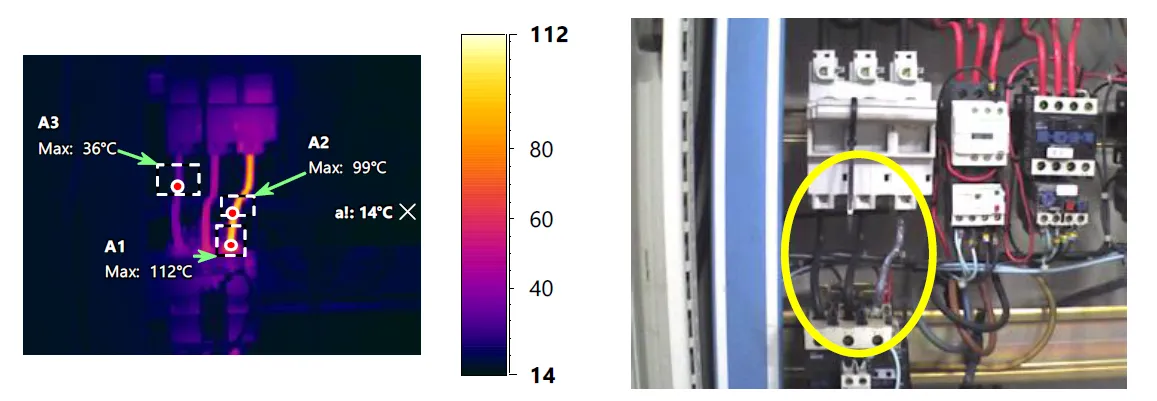
A temperature alone is not a verdict. A hot spot is interpreted against its surroundings, against similar connections under the same load (for example the other two phases) and against the load itself. A few common traps: shiny metal has a low emissivity and therefore looks colder than it is; reflections can produce an apparent warm spot; and the normal warmth of accompanying electronics is not a fault.
For every finding, the report records its location, the image pair (thermal and photo), the temperature rise, the load during the survey and the likely cause, with a priority (A/B/C) and a recommendation. The repair itself is done by a separate, authorised electrician.
Where do they usually appear?
Hot spots typically arise where there are many connections and where connections get disturbed from time to time or the load varies. Typical places: terminals of circuit breakers and fuse holders, cable lugs on contactors, busbar joints, motor feeders, and rarely loaded branches that are nevertheless used in normal operation. In a three-phase system, a telltale sign is one phase connection that is noticeably warmer than the other two at the same load.
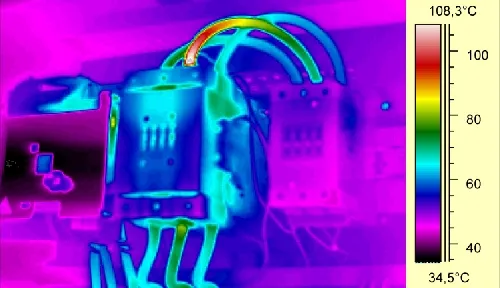
The same applies to the less dramatic cases: a temperature excess of a few degrees, but persistent, relative to the other connections is often an earlier sign than a glowing lug, and it gives a baseline for the next survey.
What is at stake?
Energy is not the stake. At the example connection, with 3,000 hours a year at that load, the loss is about 38 kWh, or HUF 5,100 a year; the range (1,500–6,000 hours of load a year) is 19–77 kWh, i.e. HUF 2,000–HUF 12,000. On all three phases the annual value is about HUF 15,000. That is negligible.
The real stake is failure and fire. We do not put a forint value on it, because we have no reliable source for the cost of downtime. Our one sourced datum: in the Hungarian disaster-management authority's 2022 investigation sample, 73 of 736 investigated fires (9.9%) had electricity as the cause; this is a sample across all building types, not a forecast for your facility.
Fixing a known fault is typically the smaller item: by our indicative, quote-based estimate, re-torquing terminals and checking costs about HUF 45,000 (range 25,000–90,000 HUF), and replacing a terminal or contactor about HUF 120,000 (60,000–250,000 HUF). Repair prices are assumptions; the electrician's quote gives the exact cost.
Where does the thermal survey end?
- Only visible surfaces can be measured: connections behind covers cannot.
- Without load the fault does not show; “no hot spot found” applies only to the moment and load of the survey.
- A thermal image does not verify tightening torque, insulation condition or the operation of protective devices.
The mandatory cycles, and how a thermal survey differs from a certificate and an audit, are covered in a separate article.
What to prepare
- Mark the cabinets to be surveyed and give an estimate of their operating load.
- Make sure the equipment runs at normal (preferably near-peak) load during the survey.
- Ask an electrician to open the cabinets safely for the time of the survey.
- If an inspection or maintenance has been done, the records help in interpreting the findings.
Cabinet screening is offered alongside a survey package at an indicative price of HUF 12,000 + VAT per cabinet (not a safety inspection). Details: electrical cabinets, service page.